
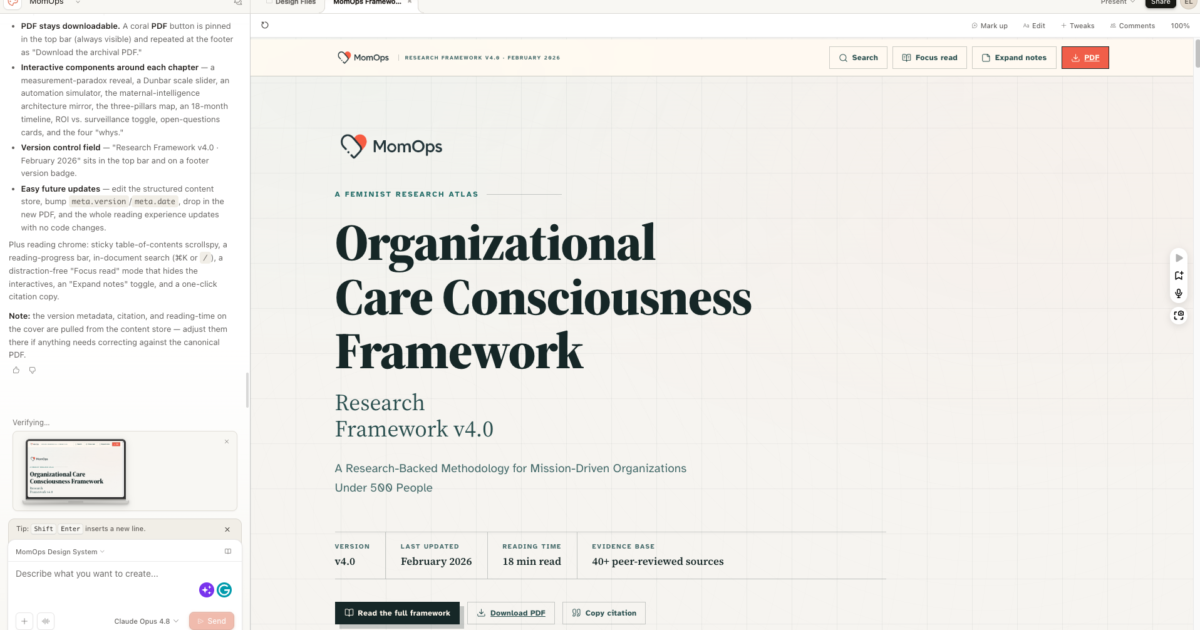
A static PDF was not enough for a framework about invisible labour, maternal cognition and care as infrastructure.
At first I imagined the MomOps framework as a polished PDF,after all I am designer, but I didn’t want to pay to use Adobe InDesign no more. Still, I wanted something people could download, read and reference. But the more I developed the work, the more wrong that format started to feel. A framework about invisible labour, maternal cognition, burnout and care infrastructure cannot really be frozen. The work is alive. The evidence keeps moving. My thinking keeps sharpening. The projects around it, especially FemHealth.science and ReturnKi.life, keep revealing new patterns.Then I started my new portfolio version and I had a realisation.
Then structure the blog like this:
- The PDF problem
A PDF is useful, but it can become a graveyard for ideas. You publish it, share it once, and then the work starts ageing. For MomOps, that felt wrong because the framework is not only a statement. It is a system I am still developing through research, product work, writing and lived observation.
- The influence of FemHealth.science
FemHealth.science changed how I think about knowledge access. It showed me that making information available is not the same as making it usable. Women’s health research can technically exist and still be hard to reach, hard to read, or hidden behind systems that were not designed with the public in mind. That insight shaped how I started thinking about MomOps too.
- Why MomOps needed to become live
MomOps is about making invisible care work visible. So the format had to support that. I wanted people to move through the framework, not just skim it. I wanted the experience to show layers: cognitive load, workplace structures, health, family systems, emotional labour and institutional blind spots.
- Using Claude Design
I used Claude Design to explore how the framework could become a live, interactive document. Not just a website page. Not just a PDF viewer. Something closer to a living publication that can be updated, expanded and downloaded when needed. The tool helped me move quickly from idea to working prototype, which matters when you are building across many projects at once.
- What this changes
Now the framework can evolve with the work. I can update sections, add research, connect it to new essays, and build interaction around the hidden cognitive load women carry. It becomes less of a document and more of a public knowledge system.