
My brain dump

So I have Ollama for a while on my Mac…do I use it? Almost never.

I also need to user Hugging Face more, for me it\’s likepart GitHub for ML, part distribution layer, part hosted inference layer.

I rarely use GitHub but since vibe coding I started using a bit more with the help of the Assistant feature inside Comet. I need sometimes to download the websites I build in Figma Make and upload them to Vercel

Ollama = “I want to run a model locally with simple commands and a local API.”

Hugging Face = “I want to find models, compare them, download them, fine-tune them, host demos, or call hosted inference.”

So what does that all mean? I was only affirming what I know and also researching new tools. I will give Replit a try and also I gave both Replit and

Em Português, o que eu faço?

Em todos os trabalhos que tive, as habilidades fundamentais eram as mesmas. O que mudava eram as atividades e os skills adjacentes, quase sempre definidos pelo contexto. Fiz pesquisa qualitativa e quantitativa, UI design e, em alguns momentos, tarefas típicas de PM. Mesmo quando atuei só como UX Researcher, meu background em UI ampliava a leitura do sistema.

Meu novo projeto: Tinytravelindex.com

\"\"

Understanding LLMs: Key Concepts and Applications

LLMs

  • An LLM is basically a giant autocomplete: it predicts the next token (piece of text) given all previous tokens.
  • Under the hood, text is split into tokens, turned into vectors (embeddings), run through a transformer network that looks at all tokens in context, and then generates the most likely next token repeatedly until it’s done.My favourite is Anthropic and then the usual ChatGPT, which I cancelled. I will give Mistral a try and I also use Perplexity a lot (which is not exactly a LLM)

Prompt engineering

  • Prompt engineering is the craft of structuring instructions and inputs so the model does what you want (role, task, format, constraints, examples).
  • Techniques include breaking a task into sequential prompts, asking for step‑by‑step reasoning, asking it to generate needed background knowledge first, and iteratively refining the prompt based on previous outputs.Your learn to prompt better when you see how many credits you wasted.

Vibe coding

  • Vibe coding is coding by describing what you want in natural language to an AI, letting it generate most of the code, and steering with feedback instead of hand‑writing every line.
  • The developer focuses on high‑level intent, testing, and iteration, often accepting AI‑generated code without deeply reading it, “programming in English” more than in a specific language.So many Apps for this. I need to write a whole blog about it but so far I have been using only Figma Make, my goal is to move to Framer.

Tool use, function calling, MCP

  • Tool use / function calling: the LLM decides when to call predefined functions (e.g. search_flightsget_user_profile) with structured arguments, gets back JSON, and then explains results in natural language.
  • MCP (Model Context Protocol) is one way to expose a set of tools to the model via a registry, so the model can discover available tools and invoke them consistently from one place.

Context windows

  • A context window is the maximum amount of text (tokens) the model can “see” at once—like its short‑term working memory for a single conversation or request.
  • Everything inside the window (your prompt, prior turns, retrieved docs) is considered together with the model’s trained knowledge to produce the next tokens; anything beyond it is “forgotten” unless re‑included.

AI agents

  • An AI agent is a system that uses models plus tools, memory, and sometimes planning to pursue goals and take actions on a user’s behalf.
  • Compared to a basic chatbot, an agent can reason about what to do next, plan multi‑step tasks, act proactively (e.g. call APIs, send messages), and adapt based on what it observes.Currently using Computer from Perplexity and CoWork from Anthropic.​

RAG (Retrieval‑Augmented Generation)

  • RAG connects an LLM to an external knowledge base: for each query, it retrieves relevant documents, stuffs them into the context window, and then asks the model to answer using that material.
  • This lets you keep the base model general, while keeping answers up‑to‑date and grounded in specific corpora (e.g. product docs, SOPs, internal Notion), reducing hallucinations.

AI evals

  • AI evals are systematic ways to test and measure how well an LLM or agent performs on tasks—for example, accuracy, relevance, safety, bias, and task‑success rate.
  • Methods range from fully automated checks, to using an LLM as a “judge” of another model’s outputs, to human review; strong setups combine several of these and track scores over time as you change prompts/models. I am using this concept in CAREVAL.

Designing AI interfaces

  • AI‑driven UIs should clearly set expectations, show what the system is doing (and why), and make it easy to correct or refine outputs (e.g. editable prompts, chips, examples, and quick‑actions).
  • For personalization and data use, explain why you need specific data, give control/opt‑outs, and adapt not just content but the interface state to what the user is doing right now, without feeling creepy.
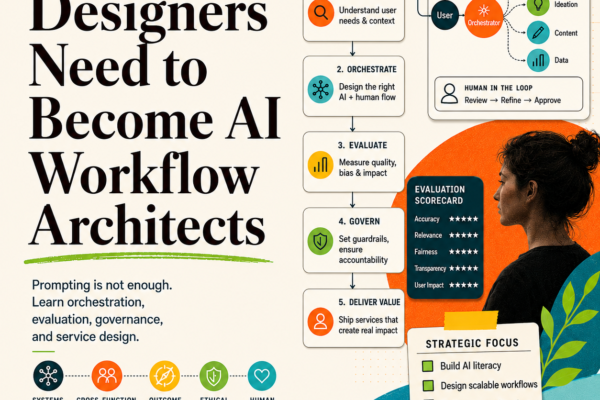
  • ​Best APP for this so far is a combo of Figma and Figma Make. You make your static UI then paste on Figma Make and ask for a pixel perfect copy of the the UI and if you want a working app, you detail the functionalities.

Debugging Made Easier: Embrace AI in Development

I have been vibing coding a lot. A lot that now that Figma is enforcing the credits, I ran out of them. I ran out of the Enterprise account credits and my personal one ran out, but it reset in one day. My take is that just now with AI agents such as the one in Perplexity inside Comet and Computer, I have been able to pay more attention to debugging. Before I would debug without agents through prompts and I would lose a lot of credits. Now I am more economical and tech-savvy because I want to outline the design plan with the design system with tokens using certain frameworks or not before I start.

\"\"

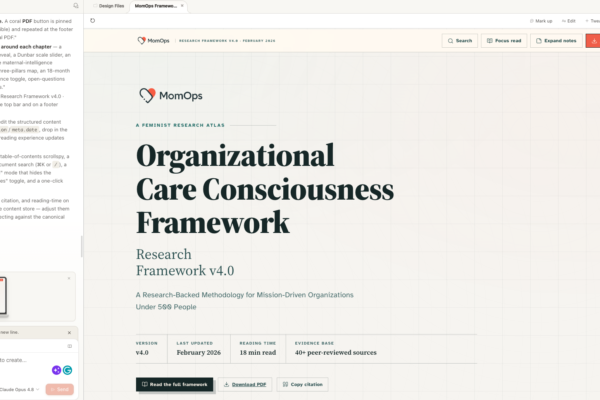
I ask AI to add .md files explaining all the functionalities too. Meanwhile, I use MomOps.org as my base to build:

  • Tinytripindex.com (Traveling with babies can be daunting, and knowing which hotels accommodate babies 6+ is not an easy task; this site makes it easier for you.)
  • Carefolio.io (I created a rank, so you will know which companies invest in and care about women.)
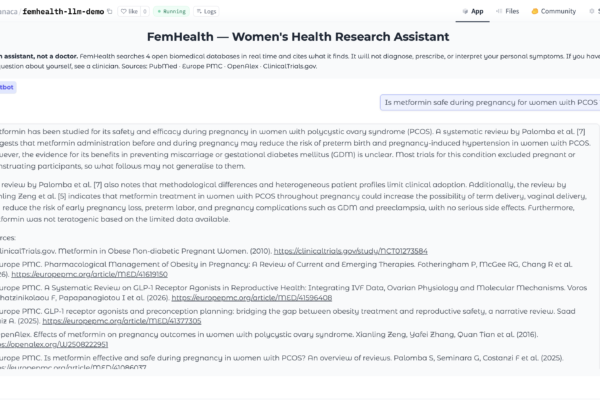
  • Femhealth.science (my main project and where I spend all my Figma Make credits.)
  • Archive of Possible (repository of lost projects, such as vaccines, research, etc.)
  • Countme In (about dyscalculia.)
  • ReturnKit (about the childcare gap and mothers returning to work.)
  • Littlebites.io (pivoted and now I rank baby food.)

I also have other projects going, but those are the main ones… nevermind, I do outside my day job work hours, so progress is not linear.

I have to say, doing that enhanced my work skills as well. It helped during maternity leave and postpartum too; it helped to stay a bit sane.

How Effective Altruism is Shaping My Approach to Business and Women in Tech Advocacy

As I finish the Going for Growth program and work on my business plan, the course on Effective Altruism (EA) has been very helpful. It’s given me new ways to think about my business and my role in advocating for women in tech. Here’s how it has made a difference.

\"\"

Using Effective Altruism in My Business Plan

In business, you often have to make choices about where to put your time and money. You want to solve big problems, but you also need to make sure you can actually make progress. The Importance, Tractability, and Neglectedness (ITN) framework that I learned in the EA course has been very useful for this.

For example, I want to help women in tech, but I’ve realized there are already many programs working on certain issues. Using the neglectedness part of the ITN framework, I’ve identified areas like maternity leave impact on career for women that need more attention. This allows me to focus on solving problems that are important and where my efforts can make a real difference.

Making Decisions: Risk vs. Certainty

One of the most interesting parts of the EA course was a discussion about risk. We talked about a situation where you can save 400 lives for sure or try to save 500 lives with a 90% chance but risk saving no one. This made me think about business decisions—sometimes I can choose a safer option, and other times, it’s better to take a risk for a bigger reward.

In my business plan, I face a similar choice: do I start small and grow slowly, or take a risk and try to grow faster? The EA course has helped me better understand when it’s smart to take a risk and when it’s better to play it safe.

Using QALYs for Social Impact

The concept of Quality-Adjusted Life Years (QALYs) is usually used in healthcare to measure how treatments improve life. But I realized it can also be used to think about how my work in women in tech advocacy can improve lives.

For example, helping women in tech with mentorship and career growth may not save lives in the traditional sense, but it can greatly improve their quality of life and future opportunities specially after maternity leave. Using QALYs has helped me see how I can make a real impact in the lives of the women I want to support.

Conclusion: Making Smart Choices for Growth

The Effective Altruism course has taught me how to make better decisions, both in business and in my work supporting women in tech. By using tools like the ITN framework and QALYs, I can make sure that the choices I make have a positive and lasting impact.

As I continue with the Going for Growth program, these ideas will help me build a stronger business and advocate for women in tech in a way that truly makes a difference.

The Tech Career Trap: Redefining Success from the Maternity Ward

\"\"

My maternity leave has gifted me an unexpected vantage point, a pause button on the career treadmill that\’s allowed me to reflect on a quote that\’s been niggling at the back of my mind:

\"\"

\”At this point in your career, your only possible promotion is to management, where you will stop doing the work you love and use a skill set you don\’t have and we don\’t teach.\”

These words hit differently now, viewed through the lens of impending motherhood and temporary career hiatus. They prompt me to question: Is this really the only path forward? And how does taking time out for family fit into this rigid career structure?

The Maternal Ceiling

As a Brazilian-born woman who\’s called Ireland home for 14 years, I\’m no stranger to navigating cultural shifts. Yet, the transition to motherhood while maintaining a tech career feels like venturing into uncharted territory. The \”maternal wall\” – the career barriers faced by women when they become mothers – is real and often intersects with the pressure to move into management. This challenge is particularly acute in tech, where women are often having children later in their careers, just as they\’re primed for leadership roles.

A study by the Universities of Bristol and Essex in the UK, based on data from Understanding Society, sheds light on this issue. The research found a significant divergence in career paths during the early years of parenthood. While 26 per cent of men were promoted or moved to a better job in the first five years of their child\’s life, only 13 per cent of women experienced similar career advancements. These figures starkly illustrate the challenges women face in maintaining career momentum after becoming mothers.

In Ireland, Research by Associate Professor Yseult Freeney and her colleagues at Dublin City University reveals a stark reality for women returning to work after maternity leave. In a 2018 report, they found that while 67% of women were enthusiastic about returning to work during their maternity leave, this plummeted to just 40% by the end of their first day back. Even more telling, their determination levels dropped from 72% to 56%, and their excitement fell from 40% to 25%.

Couple this with the expectation to move into management roles, and we\’re looking at a double-edged sword that many women in tech must face.

Redefining Success from the Nursery

My maternity leave has become an incubator not just for my child, but for new ideas about career progression. Here are some thoughts I\’ve been nurturing:

  1. Flexible Career Paths: Why does progression have to be linear? Perhaps it\’s time for a more fluid model that allows for pauses, pivots, and parallel moves.
  2. Remote Leadership: If the pandemic taught us anything, it\’s that remote work is viable. Could this open up new possibilities for balancing parenthood with technical leadership roles?
  3. Part-Time Technical Tracks: What if we created senior technical roles that could be done part-time or with flexible hours, allowing parents to maintain their technical edge while balancing family responsibilities?
  4. Returnship Programs: Initiatives specifically designed to help parents re-enter the workforce and quickly get up to speed on missed technological advancements. While programs like Women Returners exist, there\’s a pressing need for more widespread adoption of such initiatives specifically in the tech industry. We need a tech-focused comeback program that addresses the rapid pace of technological change.
  5. Mentorship Matchmaking: Pairing new parents with senior professionals who\’ve successfully navigated the work-family balance in tech.

A Personal Crossroads

I find myself at a crossroads familiar to many women in tech. Do I push for that management role, potentially sacrificing the hands-on work I love? Do I fight to maintain my current position, possibly stunting my career growth? Or do I forge a new path entirely?

I\’m reminded of the day I decided to leave Brazil for Ireland, armed with nothing but a student visa and a sense of adventure. Perhaps this juncture calls for similar courage – to demand a career path that honors both my technical skills and my new role as a mother.

As I prepare for my return to work in a couple of months, I\’ve already started planning conversations with my manager about expectations and potential flexible working arrangements. I\’m hoping to explore a gradual return to work, perhaps starting with a part-time schedule that allows me to ease back into my role while adjusting to life as a working mother.

The View from Here

From where I sit, nestled in this brief respite of maternity leave, the tech industry\’s rigid career structures look increasingly outdated. They fail to account for the richness of experience that parenthood brings – the enhanced empathy, the stellar multitasking skills, the crash course in crisis management that is caring for a newborn.

As I prepare to re-enter the workforce in a couple of months, I\’m committed to being part of the change. Whether it\’s advocating for more flexible career paths, mentoring other women navigating this journey, or simply sharing my story, I believe we can create a tech industry that values both technical excellence and life experience.

My hope for the future? To return to a workplace that sees my motherhood not as a career obstacle, but as a valuable addition to my professional toolkit. I dream of a tech industry where taking time for family doesn\’t mean stepping off the career ladder, but rather adding a new, enriching dimension to our professional lives.ding a new, enriching dimension to our professional lives.

A bit about me

A journey through design, research, and discovery. Here,I, share my passion for unraveling the complexities of user experience, bridging the gap between technology and people with empathy and innovation. With over seven years of experience across continents and industries, from the analytical rigor of Eurofins to the financial tech landscapes of Payroc, and now enhancing medical equipment usability, my path is a testament to the power of user-centered design.

Late night post

Discovering I had ADHD as an adult was a revelation that came with its mix of relief and regret. For years, I mistook my symptoms for personal failings: lack of discipline, inability to focus, and a penchant for procrastination. This late diagnosis, however, has been a turning point, giving me clarity and a path to understanding myself better.

Today was one of those days where the morning seemed to slip through my fingers, filled with procrastination instead of productivity. By the afternoon, I had managed to gather my focus, but it\’s clear this pattern isn\’t sustainable. I\’m at a crossroads, contemplating whether therapy methods or medication might offer a better path forward.

I am considering leaving art therapy again and going back to CBT.

Cognitive Behavioral Therapy (CBT) has shown promise for individuals with ADHD. It’s not just about talking; it’s a hands-on approach to change thinking and behavior patterns that hinder focus, productivity and many other issues. Techniques from CBT can help develop strategies to overcome procrastination, organize tasks, and manage time effectively. I usually mix CBT with mindfulness which is called Mindfulness-Based Cognitive Therapy (MBCT)

Creating a structured daily routine might help me combat those lost mornings. My problem is consistency. Sometimes I just don\’t feel the vibe. Breaking tasks into smaller, manageable steps , using pomodoro technique , binaural sounds etc. I use everything and more.

Starting over

How many times have I started a blog, a WordPress, and even other platforms? Honestly, too many to count. And here I am, having signed up for this WordPress, already regretting it. Chances are, I\’ll probably move the domain to WordPress.org and host it elsewhere because I don\’t want to pay just to customize things.

\"\"

In my creative process, I need to brainstorm, and eventually, I want to get back into coding just for fun an that will be interesting now that I have AI to help . It\’s tough. Last year was a whirlwind of changes for me. I got pretty busy, decided to stop being a UX/UI designer, aka Product Designer, and became what I really wanted – a UX researcher. It\’s fascinating how, when I really want something, I have this immense strength and adaptability.

I\’m pretty resilient, and unfortunately, I learned that in childhood… but you know what they say, right? People who thrive in life have usually gone through some sort of trauma… just the right amount, not enough to turn into a vice. Maybe my vice was food.