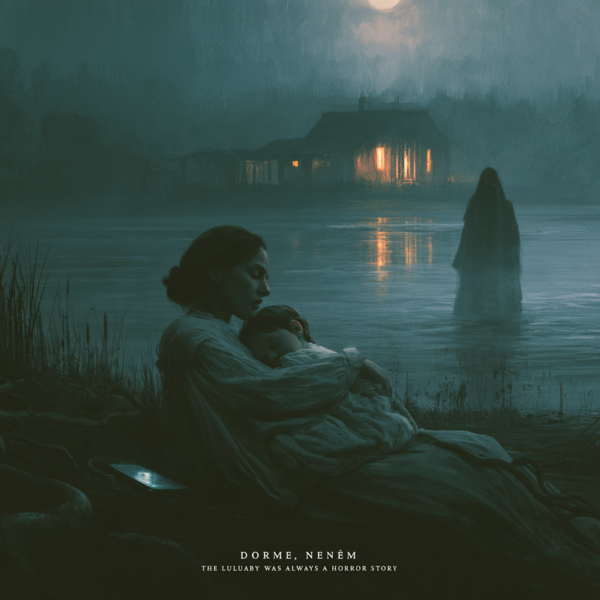
When I was a child back in Brazil, the monster was not only in the song.
We lived near a riverbank, and when we children were too loud, too wild, too unwilling to go to sleep, my grandfather’s niece would sometimes dress as an old woman and come from the direction of the river at night. I remember the figure of her: strange, bent, frightening, emerging from the dark as if the river itself had sent her.

We would scream and run. And then, suddenly, we were ready for bed.
So when I think about the Cuca now, I don’t think only of folklore. I think of performance. I think of adults turning fear into theater. I think of a child’s body understanding danger before the mind has words for it. We did not have only the lullaby. We had a live one.
“Dorme, neném, que a Cuca vem pegar…”
Sleep, baby, or Cuca will come get you.
I knew the song before I knew what it meant. As a child, I don’t remember finding it strange. Children accept monsters as part of the weather of the world. The Cuca was not an idea to be analysed; she was simply there, waiting somewhere outside the circle of light. Like the dark hallway. Like the space under the bed. Like the river at night.
But now I have a child of my own, and the song comes back differently. I hear the melody first, soft and familiar, almost automatic. Then the words arrive a second later, carrying their little knife. Sleep, or something will come and take you. And I stop. I think: one day she will understand this. One day she will hear what I am actually saying.
That is the strange thing about old children’s songs. They are tender and terrifying at the same time. They rock the child with one hand and point toward the monster with the other.
The Cuca, or Cuco, or Coco, or Cucuy, depending on the country and language, belongs to a large family of bedtime threats. The creature changes shape from place to place, but the function remains remarkably stable: it comes for children who do not sleep, who do not obey, who wander too far from safety. In Brazil, Cuca is often imagined as a witch-like figure, later made famous as an alligator-headed monster in children’s television. In Spanish and Latin American traditions, El Cuco or El Cucuy is closer to the bogeyman: the thing that waits, watches, and takes.
The lullaby is simple. Almost brutally simple. There is no elaborate moral. No explanation. Just a bargain:
Sleep, and you are safe.
Stay awake, and you are available to fear.
I used to think of songs like this as odd remnants of the past, the kind of thing people repeated without thinking. But maybe that is not quite right. Maybe people repeated them because they worked. Before child psychology, before gentle parenting, before night lights shaped like clouds and sleep-training books and baby monitors, there was the old technology of fear.
Do not go near the river.
Do not wander into the forest.
Do not touch the fire.
Do not leave the bed.
Sleep, because there are snakes.
That last one matters. In many places, fear was not metaphorical. It was practical knowledge. If you lived near water, forest, open land, or places where animals moved at night, sleep was not only a routine. It was survival. A child wandering in the dark could meet snakes, insects, deep water, strangers, cold, spirits, or whatever name a culture gave to danger.
I think about Indigenous knowledge here too, and how often stories carry instructions for staying alive. A warning may sound supernatural, but underneath it there is usually geography. Don’t go there. Don’t go now. Don’t go alone. The monster marks the boundary.
A plain warning is forgettable. A monster is not.
And then Stephen King put another layer on it.
In The Outsider, King takes El Cuco and turns the old bedtime threat into a modern horror story. The monster is no longer just a name in a song. It becomes a creature that feeds on grief, violence, and the suffering left behind after a child is harmed. King does what horror often does best: he makes the metaphor literal. The thing parents fear most is given a body. The nursery warning becomes an adult nightmare.
Hopefully my child will not watch The Outsider anytime soon. But the connection stayed with me. Because once you notice it, you realize King is not inventing something new so much as opening an old door. The monster was already there, waiting inside the lullaby.
This made me think of Edward Gorey’s The Gashlycrumb Tinies, an alphabet book in which children meet absurd, elegant, terrible ends:
“A is for Amy who fell down the stairs / B is for Basil assaulted by bears…”
It is funny, but the laughter catches in the throat. Gorey once described the book as inspired by nineteenth-century cautionary tales, except his version was “punishment without misbehavior.” That phrase feels important. In older children’s stories, disaster often arrived as a lesson: the disobedient child is punished, the curious child is maimed, the greedy child suffers. But Gorey removes the lesson. His children are not bad. They are simply fragile.
That may be the darkest truth underneath all these songs and stories. Childhood has always been fragile. We may hide that fact better now, but older cultures often kept it close to the surface.
Victorian childhood, especially, can look shockingly morbid from where we stand. Children’s books were full of death, punishment, angels, sickness, ghosts, and moral warnings. Families sometimes took post-mortem photographs of children who had died, not because they were grotesque or cold, but because photography was rare and grief needed an image. A dead child might be photographed because there had been no chance to photograph them alive.
To us, this can feel unbearable. But perhaps it was also a way of admitting something we now try very hard not to say: children die. Children fall ill. Children vanish from the world. Love does not protect anyone completely.
So why did love so often speak in the language of fear?
Maybe because fear was part of love. Not the opposite of it.
The woman dressed as the old lady by the river was frightening to us. I can still remember the force of that fear: the running, the screaming, the instant obedience. But now I also see the adults behind the scene. The choreography of care. The way they borrowed the shape of a monster to pull us back from the night.
Was it gentle? No.
Was it effective? Absolutely.
And maybe that is the uncomfortable truth of folklore. It is not always kind. Sometimes it is a fence made of fear. Sometimes it is a map disguised as a nightmare. Sometimes it is a community saying: stay close, because we know what the dark contains.
As a child, I heard only the story.
Sleep, or Cuca comes.
As a mother, I hear the panic under the story.
Sleep, because I need you safe. Sleep, because night is long. Sleep, because the river is near. Sleep, because there may be snakes. Sleep, because I cannot control everything. Sleep, because I love you so much that fear has become part of the music.
So I don’t want to simply laugh at the old songs, or condemn them. They were doing something. They were crude, frightening, sometimes cruel, but they were also attempts to draw a boundary around childhood.
The question is what kind of boundary we draw now.
I don’t want my daughter to inherit only fear. I want her to inherit language. Words for danger. Words for her body. Words for discomfort, secrecy, pressure, manipulation, and trust. I want her to know that if something frightens her, online or offline, she can bring it to me without shame.
Maybe that is the lullaby after Cuca.
Not: sleep, or the monster comes.
But: sleep, and when you wake, you will have words.
Words are how we make the dark less powerful.