For most of the internet’s history, identity has been treated as something static.
A profile picture.
A short bio.
A fixed representation of who you are.
But this has always been a simplification. Because in reality, identity is contextual.We shift depending on:
- where we are
- who we are speaking to
- what language we are using
- what part of ourselves is being activated
Recently, I started exploring what happens when you treat identity not as a snapshot, but as a system.
The experiment
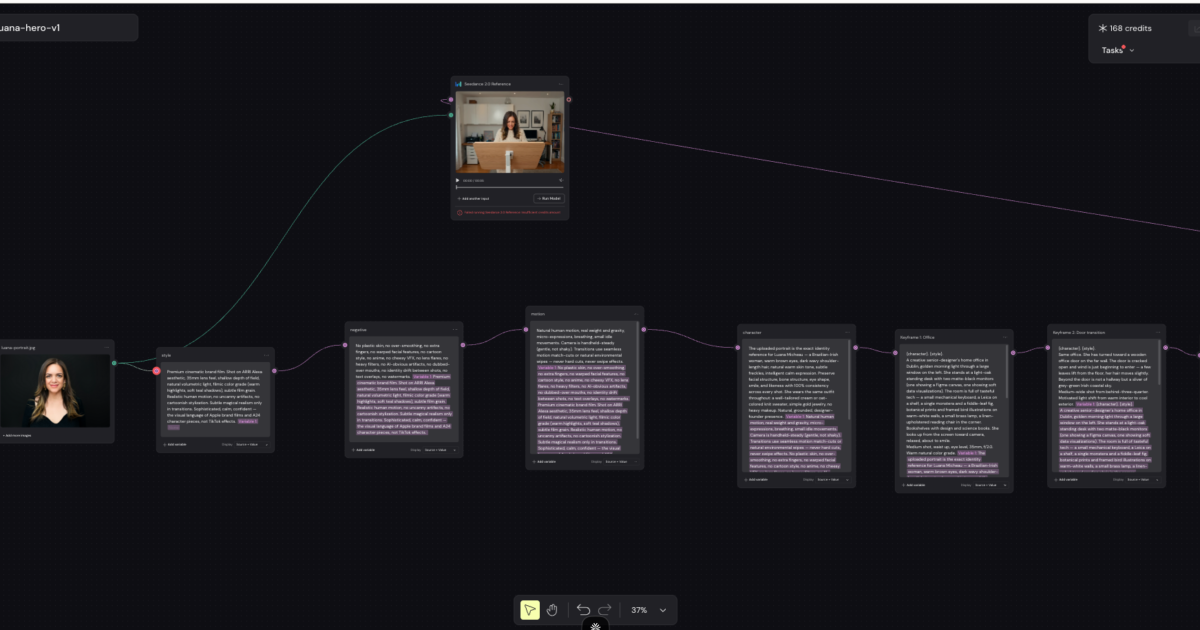
I built a small prototype using Figma Weave. It seemed a great opportunity to add some magical realism and explore my creativity…so I asked myself:
What if a profile image could become a living interface?
Starting from a single portrait, I created a sequence of transformations triggered by simple greetings:
- “Hi” → a creative office, representing systems thinking and design practice
- “Dia dhuit” → the Cliffs of Moher, grounding identity in place
- A harp moment → introducing calm, care, and emotional depth
- A toucan → a subtle reference to origin and memory
- “Oi, tudo bom?” → Rio, bringing warmth, movement, and cultural expression
The same person remains constant. What changes is the environment.
Why this matters
In product design, we often optimise for clarity, efficiency, and consistency.But in doing so, we flatten complexity.
We reduce identity to:
- a role
- a title
- a single narrative
This is useful for systems, not for humans that are adaptive and relational. So the question becomes:
Are we designing interfaces for systems…or for people as they actually are?
Identity as an interface
What this experiment suggests is that identity itself can be designed as an interface.
Not in a decorative way. But as a structured, intentional expression of:
- context
- culture
- language
- memory
- environment
Instead of a fixed profile, you have a responsive presence…
The risk
There is a fine line here. Without restraint, this kind of work quickly becomes:
- gimmicky
- overly aesthetic
- driven by tools instead of meaning
The goal is not to impress.The goal is to express something true about how humans operate.
Where this could go
This is still early.But you can start to imagine:
- onboarding experiences that adapt to cultural context
- professional profiles that change based on audience
- systems that recognise identity as fluid, not fixed
Final thought
We’ve spent years designing systems that ignore interruption, care, and context.
And maybe the next step is not adding more features…
But designing systems that reflect the way people actually exist. And the funny thing is that AI is making complex animations more accessible.