
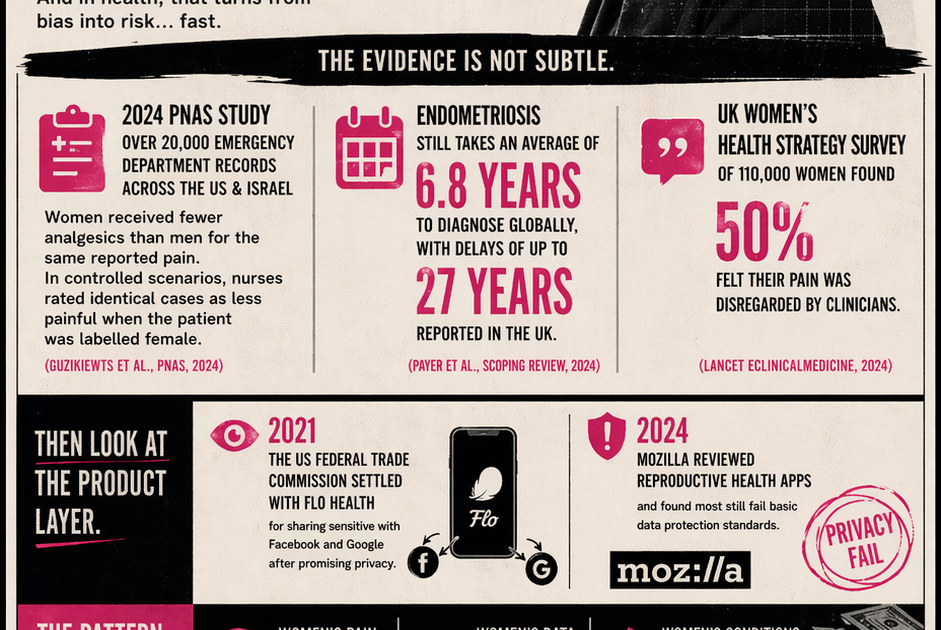
The evidence is already on the table:
In a 2024 PNAS study of over 20,000 emergency department records across the US and Israel, women received fewer analgesics than men for the same reported pain score. A controlled experiment in the same paper showed nurses rated identical case descriptions as less painful when the patient was labelled female. (Guzikevits et al., PNAS, 2024)
Endometriosis still takes an average of 6.8 years to diagnose globally, with delays of up to 27 years reported in the UK. (Fryer et al., scoping review, 2024)
A UK Women’s Health Strategy survey of 110,000 women found 50% felt their pain was disregarded by clinicians. (Lancet eClinicalMedicine, 2024)
On top of that, in 2021 the US Federal Trade Commission settled with Flo Health for sharing sensitive cycle and pregnancy data with Facebook and Google after promising users privacy. Mozilla’s 2024 privacy review of reproductive health apps found most still fail basic data protection standards.
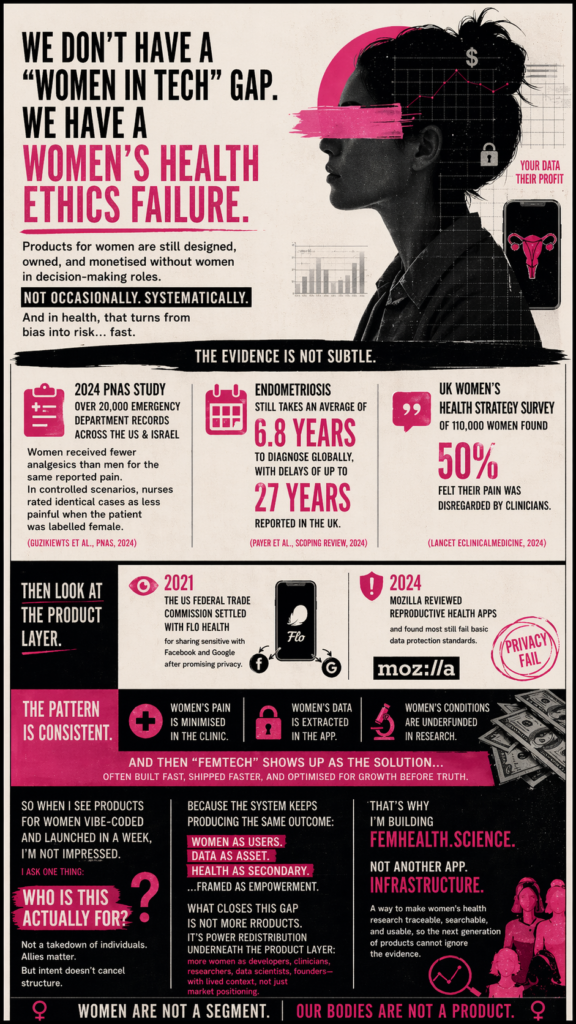
This is the pattern. Women’s pain is undertreated in the clinic. Women’s data is extracted in the app. Women’s conditions are underfunded in research. Then “femtech” arrives as the solution… often built by teams with no clinical depth, no female founders, and no accountability structure beyond growth metrics.
So when I see products for women vibe-coded and shipped in a week, I ask the only question that matters :
Who is this actually for ?
Not as a takedown of any specific founder. Allies building with women are part of the solution. The problem is the system that keeps shipping women-as-users, data-as-asset, health-as-secondary, and calling it empowerment.