
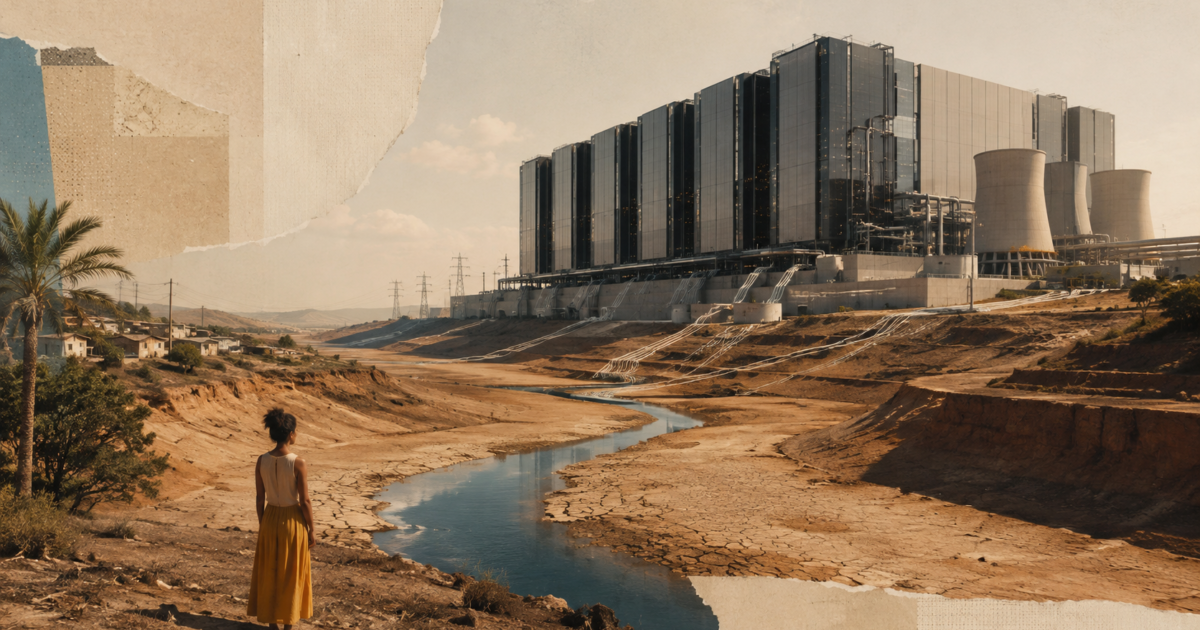
We are finding extraordinary amounts of money, energy and infrastructure for AI. I keep wondering what that says about everything else we were told would take generations to fix.
I have been thinking about AI infrastructure lately, which sounds terribly boring until you start looking at what is actually being built.
Data centres, obviously, but also power plants, transmission lines, semiconductor factories, cooling systems and all the other physical things hidden behind this rather misleading idea of “the cloud”. The International Energy Agency expects electricity consumption from data centres to more than double between 2024 and 2030, reaching around 945 terawatt-hours. AI is expected to be the biggest reason for the increase.
That is a lot of electricity. But what caught my attention wasn’t really the number. It was the speed.
We are essentially saying that, over the next few years, we can find the capital, engineering capacity, land, electricity and political will required to expand an entirely new layer of global infrastructure because AI is important enough to justify it.
And maybe it is. I use AI constantly. I build things with it, research with it, argue with it (quite a lot), and I find much of what is happening genuinely exciting. I am not particularly interested in another “AI is destroying the world” argument.
But there is another number I came across that has been sitting uncomfortably beside the first one.
In 2024, UN Women estimated that, at the rate we were progressing, ending extreme poverty among women and girls could take another 137 years.
137 years.
I know these two statistics measure completely different things. I wouldn’t put them together in a research paper and pretend there was some causal relationship between them. There isn’t.
But put them next to each other as a political question and something strange happens.
We expect the infrastructure required for AI to change almost beyond recognition by 2030. At the same time, we have become accustomed to discussing some of the most basic forms of human inequality in timelines longer than a human life.
That difference bothers me.
Not because money spent on a data centre could simply be transferred to women living in poverty. Economies don’t work like that. It bothers me because it says something about what happens when governments and markets decide that a problem is urgent.
Things move.
The cloud is actually quite heavy
One of the strange things about technology is how good we are at removing its physical reality from the interface.
I can type a question into ChatGPT while sitting in Dublin and get an answer seconds later. Nothing about that interaction makes me think about where the computation happened, what powered it or how the machines were cooled.
But AI has a body. A very large one.
Data centres consumed around 415 terawatt-hours of electricity globally in 2024 according to the International Energy Agency, and water is increasingly part of the discussion too. Some facilities use significant amounts for cooling, although this varies enormously depending on the technology, climate and location.
I mention that caveat because the environmental discussion around AI is already becoming a little silly online. I’ve seen claims that essentially turn every prompt into a glass of water stolen from somebody in a drought. That’s memorable, but it isn’t a particularly useful way of understanding the problem.
The real question is where infrastructure gets built and what happens when it arrives.
A data centre built somewhere with abundant renewable electricity and carefully managed water is one thing. Put enormous computing infrastructure in a region where the grid is already constrained or water is scarce and you have a completely different political problem.
And then there is the supply chain behind the building itself: chips, minerals, manufacturing, energy, electronic waste.
Once you start looking at that map, being Brazilian makes it difficult not to recognise something.
We have been here before, sort of
Brazil is extraordinarily rich in natural resources. This has not automatically made Brazilians extraordinarily rich.
You could tell quite a lot of our economic history through the things that left the country: sugar, gold, coffee, rubber, iron ore, soy. Obviously those industries, periods and political systems are very different from one another, and I don’t want to flatten five centuries into a clever analogy about AI.
Still, there is a recurring question underneath them that feels relevant now: where in the chain does the valuable bit happen, and who owns it?
This is why I think the AI conversation looks different depending on where you are standing.
I live in Europe now, where “digital sovereignty” is discussed quite seriously. Europe worries about depending too heavily on American technology companies, foreign cloud infrastructure and semiconductor supply chains. There are huge debates about European competitiveness and whether the continent is falling behind the US and China.
I understand the concern.
What I find interesting is that the same logic becomes even more important when you move further south.
What does AI sovereignty mean for Brazil? For Nigeria? India? Colombia? South Africa?
It cannot mean every country building its own frontier model. Apart from being financially absurd, that would create an extraordinary amount of duplicated infrastructure.
But it probably should mean something more ambitious than becoming customers.
Having millions of people using AI does not mean your country has meaningful power in the AI economy. If the models, compute, intellectual property and most profitable companies sit somewhere else, adoption and ownership are very different things.
And this is where my original question about poverty comes back.
We have a habit of calling some infrastructure an investment and other infrastructure a cost
UN Women’s latest projections suggest around 351 million women and girls could still be living in extreme poverty in 2030.
But there is another figure in their research that I find more revealing. Closing the gender digital divide could, by their estimate, benefit hundreds of millions of women and girls and add around $1.5 trillion to global GDP by 2030.
So apparently investing in women’s access to technology has a very measurable economic return.
Which made me think about the language we use around public spending.
A semiconductor plant is an investment. Childcare is often treated as expenditure.
A data centre is infrastructure. The woman who cannot take a job because there is nobody to look after her child has a “care responsibility”.
We talk about energy infrastructure, digital infrastructure and transport infrastructure all the time. Care infrastructure somehow still sounds like a feminist policy term rather than a fundamental part of an economy.
Perhaps because so much of it has historically been supplied by women for free.
This is where an intersectional feminist analysis of AI becomes useful to me. Not because every article about technology needs a paragraph saying “women will be disproportionately affected”. That sentence has become almost meaningless through repetition.
The more interesting questions are practical ones. Who has time to use these tools? Who has good internet? Who speaks a language the models work particularly well in? Who has enough education to turn access into economic advantage? Who owns a business and can use AI to reduce costs? Who is doing unpaid work while somebody else is becoming 30% more productive?
Give two people exactly the same AI tool and you haven’t necessarily given them the same opportunity.
Their starting positions still exist.
So what happens if AI really does create enormous wealth?
This is the part of the conversation where UBI usually appears.
I don’t dismiss it. Direct cash transfers have a much better evidence base than some people assume, and if AI significantly changes the relationship between labour and productivity, we may genuinely need new ways of thinking about income.
But I don’t think giving everyone money answers the bigger question.
Imagine receiving a monthly AI dividend while living somewhere without reliable healthcare, childcare, transport or broadband. The money could materially improve your life, absolutely. But you are still negotiating around missing systems.
This is particularly obvious with women because money and time are not interchangeable in quite the way economic models sometimes pretend they are. If somebody gives you €300 but you are still responsible for children, an elderly relative, cooking, cleaning and organising the household, there are limits to what the €300 can unlock.
So I am more interested in the idea of an AI dividend as public wealth rather than simply individual payments.
If AI produces the extraordinary productivity gains being predicted, what would happen if part of that gain systematically flowed into the infrastructure that gives people more agency?
Healthcare. Education. Childcare. Digital connectivity. Research. Public computing resources. Social protection. Maybe cash transfers too.
I don’t know what the correct mechanism is. An AI tax sounds satisfyingly simple until you start asking what exactly gets taxed, in which jurisdiction and how you prevent companies from moving the taxable value somewhere else. Sovereign wealth funds are interesting. Public stakes in strategic infrastructure are interesting. Requirements around community investment where data centres consume substantial local resources are interesting.
There probably isn’t one answer.
What I feel much more strongly about is who should not decide.
I don’t want technology companies becoming welfare states.
If economic survival becomes increasingly disconnected from employment, I don’t want someone’s basic income dependent on the continued generosity of whichever corporation owns the most productive model that year. Philanthropy can do useful things, but democratic redistribution and corporate generosity are not the same thing.
And this is also why simply transferring AI wealth from rich countries to poorer ones doesn’t quite satisfy me.
Ownership still matters.
I don’t want the Global South to receive the future. I want it to help build it.
There are things AI could do in Brazil that will probably never sit near the top of a Silicon Valley roadmap.
Brazil has more than 200 Indigenous languages. We have enormous regional differences in healthcare access. Agricultural problems specific to our climate. Public services operating at a scale that makes some European systems look almost experimental. We also have very good universities, researchers, engineers and one of the world’s largest digital populations.
There is no shortage of intelligence.
This brings me back to gambiarra.
People sometimes translate it as ingenuity, and I understand why. There is something wonderfully creative about making a thing work with whatever is available.
But I have mixed feelings about romanticising it.
Sometimes gambiarra is creativity.
Sometimes it is what creativity looks like when proper infrastructure never arrived.
I don’t want the Global South to become brilliant at improvising around an AI economy owned somewhere else.
I want countries like Brazil to have enough compute, research capacity, public infrastructure and local companies to decide what this technology should do for them.
That might mean regional computing facilities rather than national frontier models. More open models. Serious investment in Portuguese and Indigenous languages. South-South research partnerships. Public-interest datasets governed locally. Universities that can actually afford the compute required to participate in modern AI research.
Some of the most valuable AI applications for humanity may not produce the largest venture capital returns.
A system that improves maternal care in an underserved region may be economically tiny compared with enterprise automation in the United States.
That doesn’t make its value tiny.
It means we are measuring from a particular place.
And this is where I ended up
I started reading about the environmental cost of AI because I was worried about water.
I ended up thinking about political imagination.
Because the interesting thing about the AI boom is not only what we are building. It is how quickly we decided it was possible to build it.
Five years ago, the idea that governments would be discussing gigawatts of new electricity demand specifically because of artificial intelligence would have sounded slightly mad. Now there are national strategies for it.
Money moved. Companies moved. Governments moved. Infrastructure started moving.
Meanwhile we still describe other problems as though their timelines were almost natural phenomena.
137 years to eliminate extreme poverty among women.
Perhaps it will take that long. The world is complicated and there are no data centres we can build that magically remove inequality.
But I don’t think I can look at that number in quite the same way anymore.
Because AI has accidentally demonstrated something.
When we believe the future depends on solving a problem quickly, we become remarkably inventive about what is possible.
I want to see what happens when we apply some of that urgency elsewhere.
Not instead of building AI.
Alongside it.
And if this technology really does make the world considerably wealthier, then twenty years from now I hope we ask more interesting questions than which company built the smartest model.
Did women become less poor? Did people gain time? Did countries that had historically supplied resources finally own more of the valuable part of the chain? Did a nurse in Piauí get technology designed for the problems she actually faces? Did people who were previously outside the digital economy gain real economic power, rather than simply another app?
Those seem like fairly reasonable benchmarks for a technology we keep being told will change everything.