
Healthcare UX researchers spend a lot of time looking at healthcare literature. We read implementation science, patient experience studies, behavioural psychology, human factors engineering and clinical research.
But some of the most valuable methods for designing better healthcare experiences may be hiding in a different discipline altogether: education.
I recently came across a study by UX researcher Natalie Chiang that explores whether concept mapping improves meaningful learning among international students in an introductory economics course. At first glance, it has nothing to do with healthcare. Yet the methodology, and perhaps more importantly the problem it addresses, feels remarkably familiar.
Both educators and healthcare designers are ultimately trying to answer the same question:
How do we help people understand something complex well enough to make better decisions?
“Does this treatment or intervention work?” Instead, it asks, “How do we make sure people actually use it correctly, consistently and at scale?”
Healthcare is, fundamentally, a learning problem
Many digital health products assume patients simply need access to information.
Reality is different.
Patients are expected to understand how symptoms relate to diagnoses, why medications interact, when side effects require medical attention, how lifestyle changes affect disease progression and why treatment plans evolve after every consultation or blood test.
The same applies to clinicians. Every consultation requires connecting symptoms, laboratory results, patient history, medications, guidelines and risk factors into a coherent mental model before making decisions.
Good healthcare depends on understanding relationships, not memorising isolated facts.
Why concept mapping matters
Concept mapping is a visual learning technique that organises knowledge by showing relationships between ideas rather than presenting information as disconnected pieces.
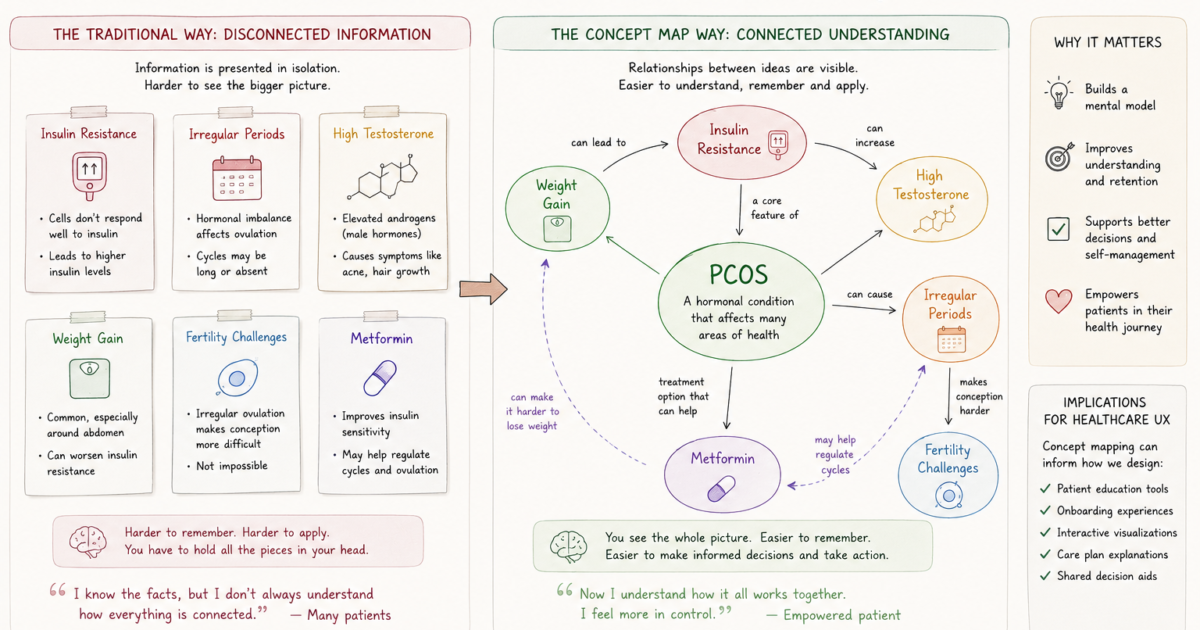
Imagine someone newly diagnosed with polycystic ovary syndrome (PCOS).
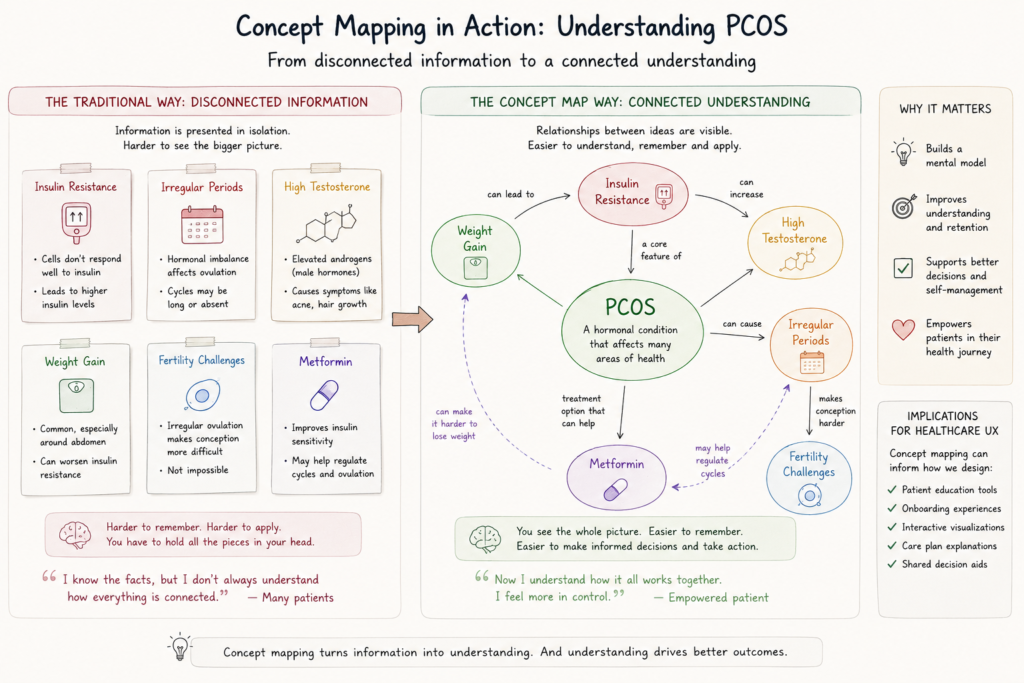
Instead of separate pages explaining insulin resistance, fertility, irregular periods, testosterone, weight gain and metformin, a concept map could show how these factors influence one another.
Suddenly, the patient isn’t memorising six different topics.
They’re building a mental model.
Research in cognitive psychology has consistently shown that meaningful learning occurs when people integrate new knowledge into existing mental structures rather than memorising isolated facts. Concept mapping supports exactly that process.
For healthcare UX, this has implications far beyond patient education.
Patient education
Patients frequently struggle to understand chronic conditions such as diabetes, heart failure, cancer or infertility because the information is fragmented across leaflets, portals and consultations.
Concept mapping offers an opportunity to organise complex medical information into understandable relationships, potentially improving confidence, adherence and shared decision-making.
Instead of asking patients to remember everything, we can help them understand how everything connects.
Clinical decision support
Doctors and nurses naturally think in relationships.
Symptoms suggest possible diagnoses. Laboratory values support or contradict hypotheses. Treatments influence future observations.
During UX discovery, mapping these relationships often exposes where Electronic Health Records fail to support clinical thinking.
Many usability problems are not caused by poor interface design.
They emerge because the information architecture doesn’t reflect clinicians’ mental models.
Concept mapping can reveal those mismatches before a single interface is designed.
Electronic Health Records and workflow design
Healthcare information is notoriously fragmented.
Laboratory systems, patient records, imaging platforms, prescribing systems and clinical notes frequently operate in isolation.
UX researchers often create concept maps during discovery to understand workflows, information architecture and decision pathways before designing interfaces.
Rather than asking “What screens do clinicians use?”, concept mapping encourages us to ask:
- What concepts are clinicians connecting?
- Which relationships matter most?
- Where does the current system interrupt their reasoning?
Those questions often lead to far better products.
Training healthcare professionals
Medicine has always been about understanding systems rather than memorising facts.
Medical schools increasingly use concept mapping to teach physiology, pathology and pharmacology because future clinicians must understand relationships across multiple domains.
The same principle applies to onboarding new staff onto complex clinical software.
Helping users understand why workflows exist is often more valuable than teaching them which buttons to click.
The research methodology may be the biggest lesson
While concept mapping itself is valuable, what stood out most in Natalie’s work was the research design.
The study combines:
- Quantitative achievement measures
- A validated motivation survey
- Qualitative interviews
This kind of methodological triangulation is increasingly important in healthcare UX.
Imagine redesigning a medication management application.
A strong evaluation wouldn’t stop at measuring task completion.
It might also include:
- Task success and completion time
- Medication error rates
- Confidence measured through validated questionnaires
- Follow-up adherence after several weeks
- Interviews exploring why patients behaved the way they did
Each method answers a different question.
Numbers tell us what happened.
Interviews explain why it happened.
Together, they create evidence that is much stronger than either approach alone.
Why regulated industries rely on mixed methods
Unlike many consumer products, healthcare products are expected to demonstrate not only usability but also safety, comprehension and effectiveness.
Healthcare organisations increasingly need evidence that users can complete critical tasks accurately, understand clinical information and maintain confidence over time.
That is difficult to demonstrate using only usability testing.
Mixed-methods research provides a richer picture by combining objective performance with subjective experience.
This is one reason researchers who are comfortable working across quantitative and qualitative methods are becoming increasingly valuable in digital health, medical devices and enterprise healthcare software.
Looking beyond healthcare for better healthcare research
Perhaps healthcare UX spends too much time looking only within healthcare.
Some of the most transferable research methods come from education, cognitive psychology, behavioural science and learning theory.
The domains may appear different on the surface, but they often share the same challenge:
Helping people build accurate mental models so they can make informed decisions.
The next breakthrough in healthcare UX may not come from another healthcare paper.
It may come from recognising that rigorous research methods travel remarkably well across disciplines.